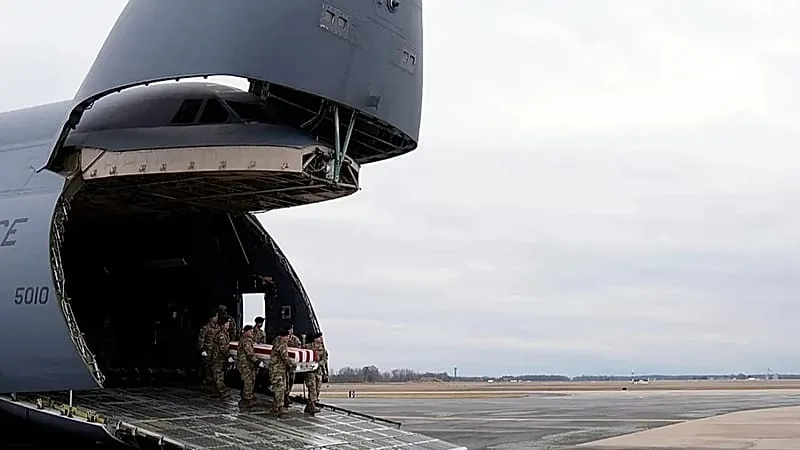
The United States launched airstrikes in Iran on Sunday, July 19, 2026, targeting sites after an Iranian attack on a base in Jordan. The strikes came in retaliation for a Saturday, July 18, 2026, incident in Jordan that killed two American service members, left one missing, and injured four personnel. The Iranian attack on the base in Jordan, which resulted in these casualties, marked a critical turning point in the escalating regional conflict. The U.S. Military action follows the start of a war launched by Israel with the United States on February 28. This broader conflict, initiated by Israel in conjunction with the United States, has been ongoing for several months, contributing to a volatile security environment across the Middle East. The retaliatory strikes represent a significant escalation in regional tensions, drawing a direct link between the attack in Jordan and Iranian involvement. This direct military response by the United States against Iranian targets signals a hardening of U.S. Policy and a willingness to engage directly in response to attacks on its personnel.
US Airstrikes Target Iran
The U.S. Military confirmed its latest strikes targeted Iran's paramilitary Revolutionary Guard, describing the actions as retaliation for the killing of American troops in Jordan. These specific targets were chosen to directly address the perceived source of the attack in Jordan and to degrade Iran's military capabilities that support its regional operations. The U.S. Military’s Central Command further detailed its operations, stating it impacted Iranian military coastal surveillance and air defense facilities. These facilities are key for Iran's ability to monitor and defend its coastline and airspace, particularly in strategically important areas. Targets also included maritime capabilities and sites used for missile and drone storage. The destruction of these sites aims to reduce Iran's capacity to launch future attacks and to project power in the Persian Gulf and surrounding regions. The coordinated nature of these strikes suggests a full effort to diminish Iran's military infrastructure deemed responsible for regional destabilization.
Iranian authorities reported a significant number of casualties following the U.S. Strikes. On Sunday, July 19, 2026, Iran stated that at least 50 individuals were killed, with an additional 517 wounded in the attacks. These figures, released by Iranian officials, highlight the severity and widespread impact of the U.S. Military operation. Iran’s atomic energy agency also reported that U.S. Strikes early on Sunday morning targeted a construction site for a planned nuclear power plant in southwest Iran. The facility, known as the Darkhovin Nuclear Power Plant, was described as a construction site. This particular target raises concerns about the potential for wider implications, given the sensitive nature of nuclear facilities, even those under construction. Satellite images reviewed from July 9, 2026, indicated that the planned Darkhovin Nuclear Power Plant site had undergone earth clearing operations but showed limited actual construction progress at that time. This suggests that while significant infrastructure had not yet been built, the site was clearly designated for future nuclear development.
In addition to the airstrikes, the United States reimposed a naval blockade on Iranian ports. This measure is a direct economic pressure tactic, aiming to halt crude oil shipments from Iran. The U.S. Military stated on Saturday, July 18, 2026, that since the re-establishment of the blockade, it had successfully redirected five ships. This demonstrates the immediate impact and effectiveness of the naval operation in disrupting Iranian maritime trade. During the same period, one vessel was disabled as part of the enforcement measures. The disabling of a vessel shows the U.S. Military's commitment to enforcing the blockade and preventing Iranian oil exports, which are a critical source of revenue for the Iranian government. The reimposition of the blockade adds another layer of pressure to the ongoing conflict, targeting Iran's economic lifelines in conjunction with military strikes.
Iranian Missile Launches and Regional Impact
Iranian missiles fired toward Jordan risked widening the conflict into neighboring Israel. The trajectory and proximity of these missile launches to Israeli territory immediately heightened concerns about regional spillover. Kuwait, Jordan, and Bahrain activated their air defenses early Sunday morning in response to incoming Iranian drones and missiles. This widespread activation of air defense systems across multiple Gulf nations illustrates the immediate and broad threat posed by the Iranian launches. Israel had warned that Iranian missiles launched toward Jordan could cause fire to spill over into its territory, marking the first such risk since fighting restarted. This warning from Israel noted the precarious nature of the conflict and the potential for any miscalculation or stray projectile to ignite a broader confrontation involving additional regional powers.
Jordan's military reported shooting down several Iranian missiles that entered its airspace. The successful interception of these missiles by Jordanian forces prevented potential damage and casualties within its borders. Separately, Kuwait reported that one of its power and water desalination plants was attacked for the second time in two days. The repeated targeting of critical civilian infrastructure, such as desalination plants, represents a significant escalation in tactics and poses a direct threat to the welfare of the civilian population. The attack on the Kuwaiti facility caused fires, according to local reports, indicating tangible damage and disruption to essential services. In Kuwait, approximately 90% of the nation's drinking water is sourced from desalination processes, making these plants absolutely vital for the country's survival and noting the severe impact of such attacks on its population.
Jasem Mohamed al-Budaiwi, secretary-general of the six-nation Gulf Cooperation Council, accused Iran of committing war crimes. Al-Budaiwi's accusation specifically cited strikes on infrastructure and civilian facilities as the basis for the charge. This condemnation from a prominent regional body adds international pressure on Iran and frames its actions within the context of international law. Such accusations can lead to further diplomatic isolation and potential legal repercussions for Iran. The targeting of civilian infrastructure, particularly those essential for basic human needs like water, is widely condemned under international humanitarian law.
Escalation and Strategic Stakes
The ongoing campaign, now in its second week, began with a struggle over control of the Strait of Hormuz. This initial phase of the conflict shows the enduring strategic importance of this vital waterway. Since the war's commencement, 16 U.S. Service members have been killed and over 430 wounded. These casualty figures show the human cost of the conflict for the United States and reflect the intensity of the engagements. Former President Trump had previously threatened to target Iran’s power stations and bridges, aiming to compel Tehran to loosen its hold on the Strait of Hormuz. This historical context notes a long-standing U.S. Concern over Iranian control of the strait and a willingness to consider significant military action to secure its passage. The Strait of Hormuz represents the narrow mouth of the Persian Gulf, through which a fifth of all oil and natural gas traded passes during peacetime, noting its strategic importance. The unimpeded flow of energy through this choke point is critical for global energy markets and the world economy, making any disruption a matter of international concern.
Iran’s Supreme Leader Mojtaba Khamenei warned of "unforgettable lessons" if the U.S. Continued attacking the Islamic Republic, according to a statement released Saturday. This stern warning from the highest authority in Iran indicates a resolve to retaliate further and signals the potential for a prolonged and intensified conflict. An Iranian negotiator also stated that Tehran was suspending its commitments to an interim deal, which had been signed approximately a month ago. The suspension of commitments to this recent deal suggests a breakdown in diplomatic efforts and a move towards a more confrontational stance by Iran. This action could have significant implications for future negotiations and international relations.
Iran’s joint military command issued a statement asserting that U.S. "covetousness, bullying, totalitarianism or brutality" would be met with a "devastating response." This highly charged language from Iran's military leadership reflects a defiant posture and a clear intent to resist U.S. Pressure with force. The statement serves as a public declaration of Iran's readiness to escalate its military actions in response to perceived aggressions. The ongoing hostilities, coupled with these strong statements from both sides, indicate a dangerous trajectory for regional stability. The strategic stakes in this conflict are immense, involving not only the security of U.S. Personnel and allies but also the global energy supply and the delicate balance of power in the Middle East. The direct engagement between U.S. And Iranian forces, alongside the targeting of critical infrastructure and the disruption of international agreements, signals a new and perilous phase in the long-standing tensions between the two nations.