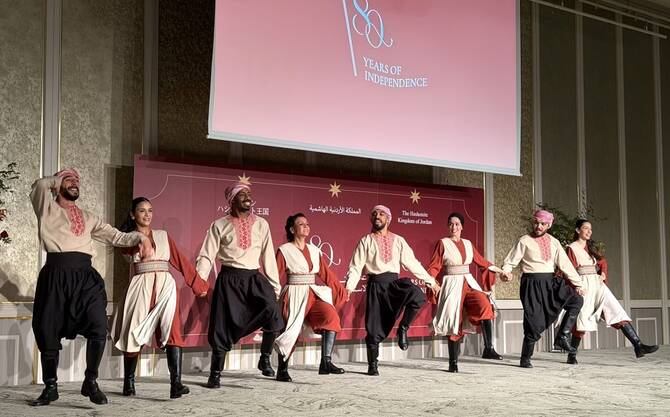
Jordanian Ambassador Nasser Shraideh hosted a gala reception in Tokyo on Tuesday, commemorating the 80th anniversary of Jordan’s independence. The event attracted hundreds of guests, including representatives from the Japanese government, its parliament, academia, the business sector, the diplomatic corps, and various friends of Jordan. During the reception, Parliamentary Vice-Minister for Foreign Affairs ONISHI Yohei commended Jordan’s key role in the Middle East. He described the Kingdom as a cornerstone of regional stability and a vital conduit for dialogue amidst ongoing tensions. The celebration showed the enduring partnership between Jordan and Japan, noting shared values and a commitment to regional and global stability.
Ambassador's Vision for Jordan
Ambassador Nasser Shraideh reflected on Jordan’s eight decades, emphasizing the nation’s resilience, sacrifice, and national pride. He stated, "Jordan serves as a bastion of stability within a volatile region." The Ambassador reiterated Jordan’s commitment to economic, administrative, and political modernization under the leadership of King Abdullah. This full modernization effort is designed to address pressing global and regional challenges. He specified that Jordan is dedicated to pursuing full modernization to address challenges such as climate change, technological advancement, and shifting geopolitics, all under King Abdullah’s guidance. This forward-looking agenda aims to ensure Jordan's continued progress and prosperity in an evolving global landscape.
Ambassador Shraideh noted the relationship with Japan, noting that "While Japan and Jordan are geographically distant, they remain close in spirit." He characterized both peoples as those who honor their heritage without being constrained by it and possess the capacity to transform scarcity into innovation. The Ambassador showed the effectiveness of cooperation, stating, "Bilateral cooperation across various sectors has successfully translated vision into infrastructure and intention into opportunity." This collaboration spans numerous fields, from economic development to cultural exchange, demonstrating a strong and multifaceted partnership. He emphasized that the strength of this bond is a testament to the shared aspirations and mutual respect between the two nations.
He also looked ahead, asserting that "The forthcoming 80 years will necessitate innovation, sustainability, and creativity." Shraideh expressed his conviction that "Progress is achieved through the construction of bridges rather than walls" and that the friendship with Japan would remain an integral component of that narrative. Japan, in turn, reaffirmed its long-standing commitment to supporting Jordan. This support particularly extends to its humanitarian efforts in hosting refugees and through various reconstruction assistance programs. This commitment reflects Japan's recognition of Jordan's significant contributions to regional stability and its unwavering dedication to humanitarian principles. The ongoing support from Japan is key for Jordan as it navigates complex regional dynamics and continues its development trajectory.
Deepening Japan-Jordan Partnership
Japan and Jordan have strengthened their relationship despite their geographical distance, with Ambassador Nasser Shraideh noting that the two nations are "close in spirit." According to Ambassador Shraideh, "Bilateral cooperation across various sectors has successfully translated vision into infrastructure and intention into opportunity." This close collaboration led the two countries to elevate their relationship to a Strategic Partnership in 2018. This elevation marked a significant milestone, formalizing and deepening the ties that bind the two nations. The Strategic Partnership encompasses a broad range of cooperation, from political dialogue to economic development and security.
King Abdullah further showed the importance of this bilateral bond by making his 13th visit to Japan last year. Such high-level exchanges are instrumental in fostering mutual understanding and charting the course for future cooperation. The frequent visits by King Abdullah highlight the strategic importance Jordan places on its relationship with Japan. The partnership also extends to defense, with ongoing unit-to-unit exchanges occurring between the Japan Self-Defense Forces and the Jordanian Armed Forces. These exchanges contribute to enhanced security cooperation and mutual capacity building. They demonstrate a shared commitment to regional peace and stability through practical collaboration.
Cultural and economic ties are also a focus, as demonstrated by Jordan's participation in international events in Japan. At the Osaka-Kansai Expo, the Jordan Pavilion featured immersive desert sand exhibitions, providing a unique cultural presentation. This exhibit allowed Japanese audiences to experience the rich heritage and natural beauty of Jordan firsthand. Additionally, attendees at the Tokyo gala were invited to view exhibits showcasing Jordan’s historic landmarks and archaeological sites, noting the nation's rich heritage and tourism potential. These cultural showcases are vital for promoting cross-cultural understanding and attracting tourism and investment. These initiatives collectively reflect the broadening scope of cooperation between Japan and Jordan across various domains, fostering a deeper appreciation for each other's cultures and economies.
Cultural Celebration and Future Outlook
The evening gala in Tokyo included traditional Jordanian music and folkloric dance performances, with performers dressed in national costumes. Guests were also offered a selection of Arabic and Jordanian cuisine, enhancing the cultural experience. The vibrant performances and authentic culinary offerings provided a rich sensory experience, allowing guests to immerse themselves in Jordanian culture. This cultural exchange served to strengthen the bonds of friendship and mutual understanding between the two nations.
Looking ahead, Ambassador Nasser Shraideh outlined a vision for Jordan's future, stating that "The forthcoming 80 years will necessitate innovation, sustainability, and creativity." He also emphasized the importance of collaboration in achieving national goals. Ambassador Shraideh noted his conviction that "Progress is achieved through the construction of bridges rather than walls and expressed his conviction that the friendship with Japan will remain an integral component of that narrative." This vision speaks to Jordan's commitment to continuous development and its belief in international cooperation as a cornerstone for progress. The celebration also acknowledged recent national achievements, such as the national football team, the “Nashama,” qualifying for the FIFA World Cup, reflecting a moment of national pride. This sporting success resonated deeply with the Jordanian people and was celebrated as a testament to the nation's growing presence on the global stage. The gala served not only as a commemoration of past achievements but also as a forward-looking statement on Jordan's aspirations and its enduring partnership with Japan.