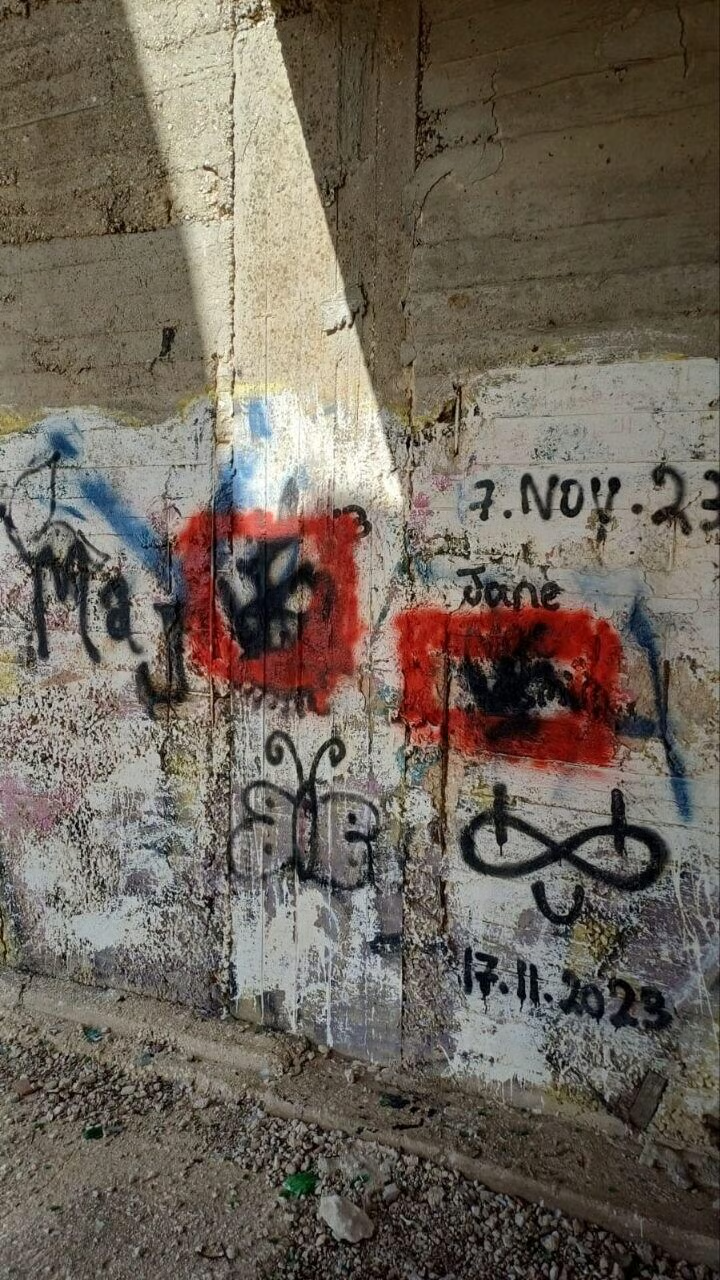
Swastikas were spray-painted on the walls of an abandoned palace in Jerusalem that was commissioned by Jordan's King Hussein in the 1960s. Ran Yishai, former Israeli ambassador and head of research at the Jerusalem Center for Applied Policy, stated, "As everywhere else, there is no vacuum in Jerusalem either. Where the State of Israel does not exercise control, others will. It will not remain empty." He added, "That is how neo-Nazis enter a historic site in the heart of Jerusalem and paint swastikas on its walls." Regarding the symbols, Yishai said, "We all know what swastikas mean, and anyone who thought they belonged to the distant past was reminded by Hamas in the communities surrounding Gaza that they are very much a part of the present."
Historical Context of Site
Construction of the palace ceased abruptly following the 1967 Six-Day War. The site is identified by some scholars as Gibeah of Benjamin, the biblical city from which King Saul ruled. Regarding the potential future of the location, Ran Yishai, former Israeli ambassador and head of research at the Jerusalem Center for Applied Policy, stated, "There are many plans to develop biblical Gibeah of Saul, and now is exactly the time to start implementing them." His assessment notes the ongoing academic and political debate regarding the significance of the grounds. While the structures remain unfinished, the historical identification of the area as a royal seat from the era of King Saul continues to influence discussions about the property's status in Jerusalem.
Archaeological Significance and Excavations
William Foxwell Albright conducted excavations at the site during the 1920s and 1930s. His research contributed to the identification of the location as the biblical Gibeah of Benjamin. Following his work, archaeologist Paul Lapp led further excavations at the grounds in 1964. These archaeological efforts aimed to uncover layers of history associated with the area, which is situated near the modern-day village of Jaba.
Vandalism at the palace has taken various forms over the years beyond the recent graffiti. A previous mural painted on the walls of the abandoned structure depicted Palestinian terrorist Leila Khaled. The presence of such imagery on the site has frequently drawn attention to the intersection of modern political expression and the historical ruins of the palace commissioned by King Hussein. While the location remains unfinished, these past artistic interventions and professional archaeological investigations document the diverse ways the property has been utilized since construction halted in 1967.