American forces destroyed five Iranian crude oil tankers on September 8, 2026, amid escalating naval confrontations in the region, U.S. Central Command (CENTCOM) announced. The destruction occurred as U.S. Warships in the area successfully evaded attempted Iranian attacks, demonstrating advanced defensive capabilities. CENTCOM reported that no U.S. Personnel sustained injuries during the operations, a critical detail noting the effectiveness of the defensive measures taken. The incident marks a significant development in maritime tensions involving the United States and Iran, signaling a direct escalation of military actions.
Escalating Naval Confrontation
The destruction of the tankers on September 8 followed two attempts by Iran's Revolutionary Guard to strike a U.S. Navy warship with ballistic missiles over the preceding two days. These aggressive actions by the Revolutionary Guard directly preceded the U.S. Response. The U.S. Warship successfully evaded the attempted Iranian attacks, preventing any damage or casualties among U.S. Personnel. The five Iranian crude oil tankers destroyed were specifically identified as Kaviz, Charminar, Horizon 1, Riesco, and Derya. This targeted action against specific vessels shows the precision of the U.S. Operation.
Separately, on Saturday, U.S. Central Command (CENTCOM) reported the destruction of three additional crude oil tankers. This earlier action was taken after the Revolutionary Guard launched ballistic missiles at a U.S. Aircraft carrier and a guided-missile destroyer, further illustrating a pattern of Iranian aggression against U.S. Naval assets. In total, the United States has destroyed eight Iranian tankers in these two distinct rounds of strikes, marking a substantial blow to Iran's maritime capabilities and its illicit financial networks.
Amidst these naval engagements, Iran claimed it had seized an unmanned U.S. Military submarine at the entrance to the Strait of Hormuz. This claim, if substantiated, would represent another layer of complexity in the ongoing maritime disputes. However, a U.S. Official, speaking to Reuters, offered a different account, stating the vessel was an older model unmanned craft that malfunctioned while surveying waters near Iran. This suggests the incident may have been less about a deliberate seizure and more about a technical failure of an older piece of equipment.
Iranian Retaliation and Regional Impact
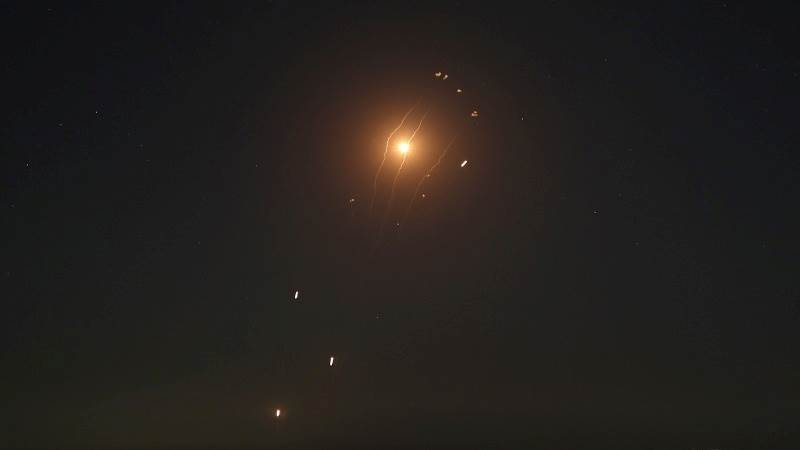
Following the American strikes on the tankers, Iran launched missiles at a U.S. Base in al-Azraq, Jordan, according to reports. This direct retaliation against a U.S. Military installation on land signifies a broadening of the conflict beyond purely maritime engagements. Concurrently, interceptions of missiles were observed in the skies over Israel, indicating a broader regional response and the potential for spillover into other areas of the Middle East. The presence of missile defense systems over Israel notes the heightened state of alert across the region.
Mohsen Rezaei, secretary of Iran's Supreme National Security Council, issued a stern warning regarding the escalating tensions. Rezaei stated that U.S. "economic warfare" would be met with "maritime measures." This declaration suggests a potential expansion of Iranian actions into commercial shipping or other naval operations in the region, possibly targeting international vessels or critical shipping lanes in a bid to exert pressure. Such measures could significantly disrupt global trade and further destabilize the already volatile region.
Context of Iran's Shadow Network
The destroyed tankers were part of a multibillion-dollar "shadow network" that Iran utilizes to finance the Revolutionary Guard and its proxy forces, according to U.S. Officials. This network operates outside conventional financial systems, enabling the Revolutionary Guard to fund various regional operations and maintain its influence across the Middle East. The U.S. Has previously targeted elements of this shadow network, asserting that it underpins Iran's destabilizing activities, including support for militant groups and interference in regional conflicts. The destruction of these vessels represents a direct action against the infrastructure supporting these illicit financial flows, further escalating the ongoing confrontation between the United States and Iran in the maritime domain and beyond. This aggressive targeting of Iran's financial lifelines indicates a strategic shift in U.S. Policy aimed at disrupting the Revolutionary Guard's ability to operate and project power.