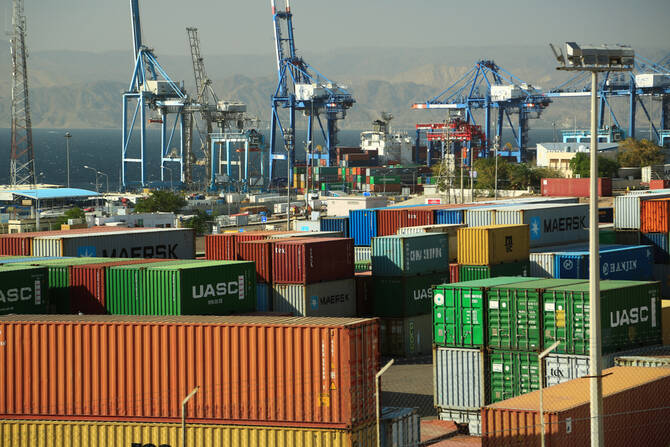
Jordan's total exports experienced a significant rise of 14.5% in the first half of 2026, a performance that directly contributed to a notable narrowing of the country's trade deficit. This strong export growth shows a positive trend in Jordan's economic activity during the six-month period. Total exports reached a substantial 6.41 billion Jordanian dinars ($9.04 billion) by the end of June, reflecting increased international demand for Jordanian goods and services.
Concurrently, imports into the Hashemite Kingdom also saw an increase, albeit at a more moderate pace. Imports grew by 6.1 percent, totaling 10.26 billion dinars for the same period. The disparity in growth rates between exports and imports had a beneficial effect on the trade balance. Consequently, the trade deficit narrowed by 5.5 percent, representing a reduction of 226 million dinars, settling at 3.85 billion dinars. This positive shift indicates an improved balance in Jordan's international trade. This strong performance also led to an improvement in the export coverage of imports, a key economic indicator, which climbed to 63 percent from the 58 percent recorded a year earlier, signaling a healthier trade relationship.
Export Composition and Growth Drivers
A closer examination of Jordan's export composition reveals distinct contributions from national exports and re-exports. National exports, comprising goods originating from Jordan, accounted for a substantial 4.67 billion dinars of the total export value. These national exports demonstrated a steady growth, increasing by 6.2 percent compared to the same period in the previous year, noting the strength of domestic production. In parallel, re-exports, which involve goods imported into Jordan and then exported again, registered a remarkably significant surge of 44.6 percent over the same comparative period, contributing 1.75 billion dinars to the total. This substantial increase in re-exports suggests Jordan's growing role as a regional trade hub.
Growth in exports was observed across several key commodity sectors, indicating a diversified positive performance. Crude potash exports, a vital component of Jordan's mining sector, saw a significant increase of 30.7 percent. Similarly, fertilizer exports, another major industrial output, experienced a healthy rise of 14.1 percent. The manufacturing sector also contributed positively, with apparel and accessories exports experiencing growth, climbing by 3.0 percent. This growth across various sectors shows the breadth of Jordan's export capabilities.
However, not all sectors experienced an increase, reflecting the dynamic nature of global trade markets. Raw phosphate exports, for instance, dropped by 7.2 percent during the period. Fine jewelry exports also faced headwinds, falling by 9.8 percent. Despite these declines in specific categories, the overall export landscape remained strong due to strong performances elsewhere.
The overall export growth was significantly bolstered by expanded shipments to several international markets, demonstrating Jordan's success in diversifying its trade partnerships. This included increased trade with neighboring Syria, indicating a potential resurgence in regional economic ties. Jordan's exports also saw a substantial boost from non-Arab Asian nations, notably China, reflecting the kingdom's growing engagement with major global economies. Expanded shipments to European Union markets, led prominently by the Netherlands, contributed significantly to the positive export performance, noting the continued importance of European trade relationships for Jordan.
Import Trends and Trade Partners
Jordan's import landscape in the first half of 2026 was marked by significant shifts across various categories, reflecting both economic activity and evolving consumer and industrial demands. Purchases of crude oil and petroleum products saw a substantial increase, jumping 58.1 percent during the period. This rise in energy imports could be attributed to increased domestic consumption, industrial activity, or fluctuating global energy prices. Grain imports, essential for food security, also rose, recording a 10 percent increase, indicating consistent demand for staple food items.
Conversely, several import categories experienced declines, suggesting shifts in domestic consumption patterns, industrial investment, or global supply dynamics. Imports of machinery and tools, critical for industrial development and infrastructure projects, fell by 23.6 percent. Purchases of precious jewelry, often an indicator of discretionary spending, also declined significantly by 19.8 percent. Imports of vehicles and cycles, another key consumer and commercial expenditure, decreased by 5.9 percent. Additionally, imports of electrical machinery and equipment saw a modest but notable decline of 2.4 percent. These varied movements in import categories paint a detailed picture of Jordan's economic priorities and challenges during the first half of the year.
Regarding trade partners, the sources of Jordan's imports remained diverse and strategically important. Saudi Arabia, the United States (US), and China were identified as among Jordan’s main sources of imports during the first half of 2026. This notes the kingdom's reliance on a mix of regional and global economic powers for its essential goods and resources, maintaining strong trade relationships across continents.
Development Funding and Projects
Beyond trade figures, Jordan also secured significant development funding in the first half of 2026, reinforcing its commitment to economic growth and infrastructure development. The kingdom signed two key agreements totaling $340 million with the Abu Dhabi Fund for Development (ADFD). These agreements show the strong bilateral relations and financial support from the United Arab Emirates.
One of these agreements provided a substantial $300 million in financing specifically to support the Jordanian government’s general budget. This direct budgetary support is key for the government to manage its fiscal obligations, fund public services, and maintain economic stability. It provides critical liquidity and flexibility for national development priorities.
A separate and equally important agreement detailed a $40 million contract designated for the construction and equipping of five public vocational and technical schools across the kingdom. This investment in education and skill development is a strategic move to enhance Jordan's human capital. These five new educational facilities are slated for construction in key regions, specifically Amman, Mafraq, Jerash, and Irbid, aiming to decentralize educational opportunities and cater to local labor market needs. The $40 million school project is financed entirely through an ADFD grant, showing the fund's direct and generous support for educational infrastructure development without adding to Jordan's debt burden.
In a further commitment to industrial infrastructure, the ADFD also pledged an additional $70 million for a significant project aimed at supplying natural gas to two vital industrial zones: the Rawda Industrial City in Ma’an and the Muwaqqar Industrial City. This initiative is designed to bolster industrial energy infrastructure, provide a more efficient and cleaner energy source for factories, and ultimately reduce operational costs for businesses operating in these industrial cities. Such investments are critical for attracting further industrial investment, creating jobs, and enhancing Jordan's overall economic competitiveness.