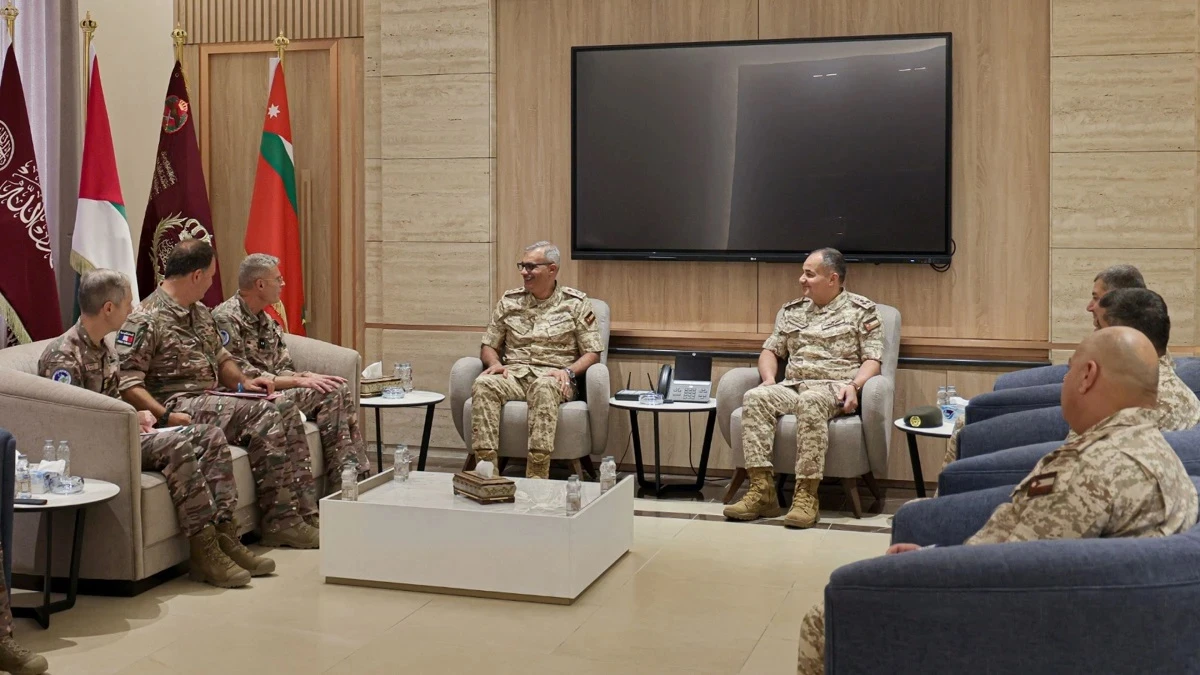
Jordan’s chairman of the Joint Chiefs of Staff, Maj. Gen. Majdi Mohammad Al-Harasis, met with Rear Admiral Yannick Bossu, commander of the French forces stationed in the UAE, on Sunday. The high-level discussion, held at the General Command of the Jordan Armed Forces-Arab Army in Amman, focused on advancing military cooperation and bolstering regional stability. This engagement shows the ongoing strategic dialogue between the two nations. Both Maj. Gen. Al-Harasis and Rear Admiral Bossu assumed their current roles amidst the ongoing Middle East conflict involving Iran, the US, and Israel, noting the critical period in which they operate. Their meeting showed shared objectives in maintaining security across the region and addressing common challenges.
Key Personnel Appointments
Maj. Gen. Majdi Mohammad Al-Harasis was appointed to his current role by King Abdullah last week, taking over from his predecessor, Yousef Huneiti. This significant leadership change positions him at the helm of Jordan's military operations. France’s Rear Admiral Yannick Bossu assumed command of COMFOR UAE in August, succeeding Rear Admiral Hugues Laine. His appointment brought with it expanded responsibilities, reflecting France's strategic interests in the wider Indo-Pacific region. In addition to his role with French forces in the UAE, Rear Admiral Bossu also became commander of the Indian Ocean Maritime Zone, extending his operational oversight. He further took on command of the national contingent for Operation Chammal, which designates French military participation in operations against ISIS in Iraq and Syria. These appointments position both leaders at the forefront of military strategy in a period of heightened regional complexity, tasking them with navigating a dynamic security landscape. Their recent ascensions to these critical positions show the importance of continuous coordination and strategic planning.
Broader Strategic Context
Operation Chammal, under the command of Rear Admiral Yannick Bossu, actively supports the anti-Daesh international force in Syria and Iraq. This mission forms part of broader regional security efforts aimed at countering extremist threats and stabilizing critical areas. The wider Middle East conflict, involving Iran, the United States, and Israel, commenced in February, adding to the complexity of the security environment. This ongoing conflict has introduced new layers of geopolitical tension and operational challenges for regional and international actors alike. During this period, both Jordan and the UAE have recorded instances of being targeted by Iranian drones and ballistic missiles, showing the direct and tangible threats faced by nations in the region. These incidents show the volatile conditions that military leaders in the region are currently addressing, requiring strong defense strategies and international cooperation. The ongoing developments necessitate continued discussions on strategic cooperation to maintain stability and mitigate escalations across various operational theaters, ensuring collective security in a precarious environment.
Meeting Participants and Location
Senior Jordanian officers participated in the discussions alongside Maj. Gen. Majdi Mohammad Al-Harasis, contributing to a full exchange of perspectives. The French delegation also included the French defense attache in Amman, whose presence noted the diplomatic and military ties between the two countries. Their collective presence showed the collaborative nature of the meeting held at the General Command of the Jordan Armed Forces-Arab Army, a central hub for Jordanian military planning. The discussions focused intently on strengthening military cooperation and ensuring regional stability, reflecting shared strategic interests between Jordan and France in maintaining peace and security. The engagement notes ongoing efforts to coordinate responses to the complex security environment in the Middle East, which demands a unified approach. Both sides emphasized the importance of continued dialogue to address evolving challenges and enhance collective security capabilities, reinforcing their commitment to a stable and secure region.