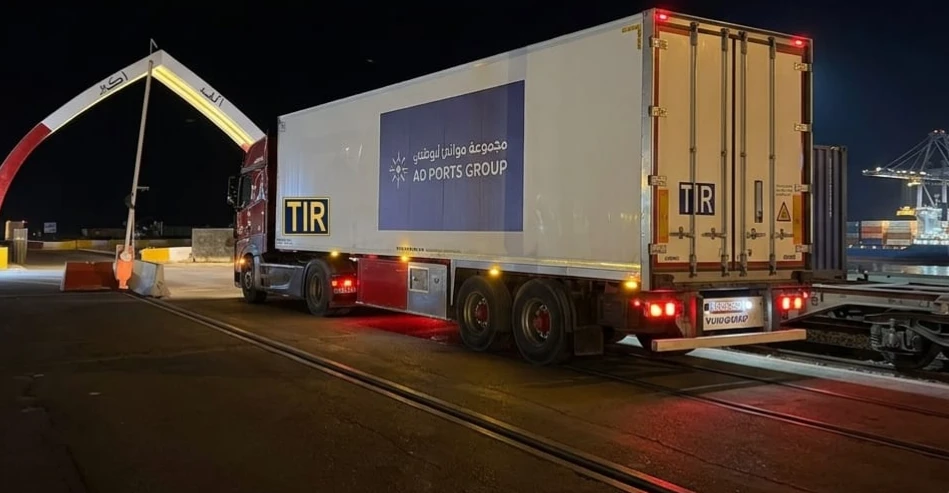
Iraq has completed its inaugural multimodal freight shipment operating under the International Road Transport (TIR) system, establishing a new trade corridor that promises to enhance regional connectivity. This landmark shipment successfully connected Jordan and the United Arab Emirates by transiting through Iraqi territory. The journey, which exemplifies a multimodal approach to logistics, originated from Jordan's Aqaba Port, a key maritime gateway. From there, the cargo traveled by road, traversing through Jordan and then across Iraqi land. Upon reaching Iraq's Umm Qasr Port, a vital hub on the Persian Gulf, the cargo was smoothly transferred for its onward sea journey to Khalifa Port in the UAE, marking an important step in regional logistics and trade facilitation. This successful completion not only signifies a new operational route for international freight but also notes Iraq's emerging role as a transit nation, leveraging its geographical position to bridge trade between the Levant and the Gulf region. The integration of road and sea transport in a single, coordinated operation demonstrates the potential for more efficient and cost-effective movement of goods across the Middle East.
Key Players and Cooperation
The complex operation was meticulously supervised by Iraq's General Company for Land Transport and the Transport Ministry's TIR coordination office, demonstrating the country's commitment to modernizing its logistics infrastructure. This initiative involved extensive collaboration with several key entities, both national and international, to ensure its successful and secure completion. Murtadha al-Shahmani, Director General of Land Transport Department, provided insight into the collaborative effort, stating, "The operation was supervised by Iraq's General Company for Land Transport and the Transport Ministry's TIR coordination office, in cooperation with the International Road Transport Union (IRU), the General Commission of Customs, and the General Company for Ports of Iraq." This high level of coordination was absolutely key for managing the intricate logistics of the multimodal shipment, encompassing customs procedures, border crossings, and the transfer between different modes of transport. The involvement of these various Iraqi and international organizations shows the collaborative effort behind establishing the new trade corridor, reinforcing trust and efficiency within the supply chain. Such partnerships are fundamental to the successful implementation and expansion of international transit systems.
TIR System Activation
The successful completion of this shipment follows a significant announcement earlier this month, when Iraq's Transport Ministry officials confirmed that the country had fully activated the International Road Transport (TIR) system. This full activation is a key development, allowing for the secure and streamlined transit of goods across borders, which is expected to significantly reduce delays and administrative burdens for transporters operating through Iraqi territory. This development paves the way for Iraq to play a more central and influential role in regional trade networks by facilitating the efficient movement of cargo through its strategic geographical position. The full implementation of the TIR system is expected to substantially enhance Iraq's connectivity, supporting its ambition to become a significant transit hub not only between its immediate neighbors but also connecting broader Asian and European markets. This activation is a key step in modernizing Iraq's customs procedures and logistics infrastructure, aligning them with international best practices and standards. By adopting the TIR system, Iraq is positioning itself as a reliable and efficient corridor for global trade, opening new economic opportunities.
Broader Trade Corridor Impact
The International Road Transport (TIR) system has proven instrumental in establishing new logistical pathways globally, having successfully opened seven international trade corridors over the past eight months alone. This rapid expansion demonstrates a significant and concerted push toward integrated regional transport networks, aiming to foster greater economic integration and trade. These newly established corridors have facilitated a substantial increase in freight movement, enabling more than 1,000 cross-border freight movements during the same eight-month period. This high level of activity shows the growing and vital role of the TIR system in enhancing connectivity and streamlining trade operations across participating nations, contributing to a more efficient and secure transit of goods globally. The system's ability to reduce transit times and costs makes it an attractive framework for countries looking to boost their trade volumes and improve supply chain resilience.