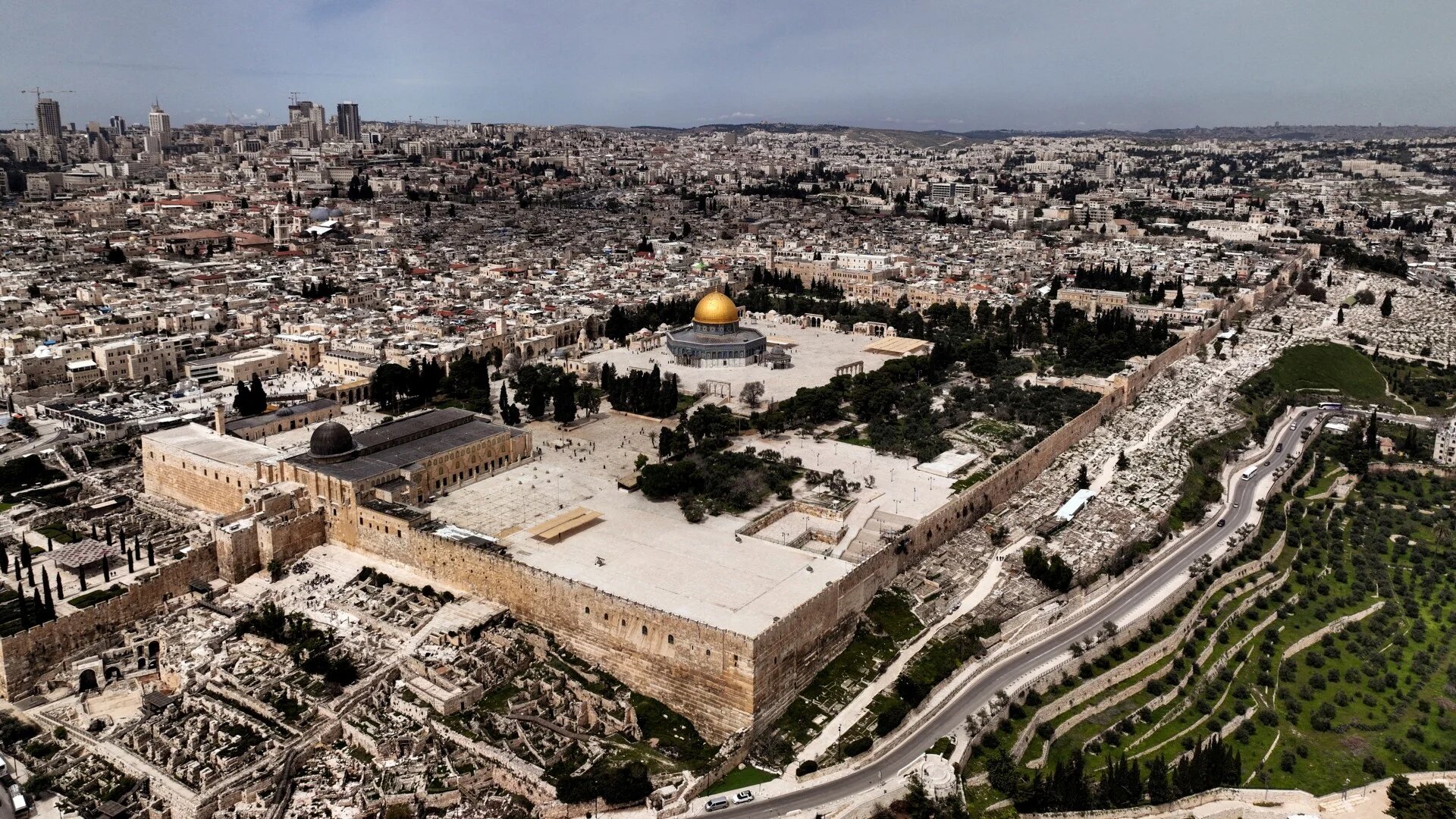
Claims have emerged that the US and Israel are 'actively working' to strip Jordan of its historic custodianship over Jerusalem's Al-Aqsa Mosque complex. According to these claims, a new arrangement for Al-Aqsa Mosque is being pursued that would align its management closely with Israeli interests. This proposed "new arrangement" would reportedly grant Jews "equal access" to the Muslim holy site and formally permit large-group Jewish prayer within the complex. The pursuit of this new arrangement is alleged to be a joint effort by the US and Israel, aiming to fundamentally alter the governance of one of the most sensitive religious sites in the Middle East.
Under the alleged plan, Israel would also gain involvement in approving the content of Friday sermons delivered at the mosque. Reports suggest Israel would have a major say over the appointment of imams, preachers, and senior mosque officials. However, a US official has denied these allegations, stating that the White House is not actively working to remove Jordan's custodianship. The official described the report as "totally false," countering the assertions of a concerted effort to change the status quo.
Details of Proposed New Arrangement
The alleged plan, reportedly championed by President Donald Trump's son-in-law Jared Kushner and US ambassador to Israel Mike Huckabee, would lead to the abrupt termination of the authority held by the Jordanian-backed Islamic Waqf. Under this proposed arrangement, a new body established by the Israeli government would declare the Al-Aqsa Mosque a 'multi-faith centre'. Reports also indicate that Israel would gain substantial influence over the appointment of imams, preachers, and other senior mosque officials, effectively taking control over the religious administration of the site.
Sources suggest the Trump administration's objective is to strip the Al-Aqsa Mosque of its Muslim identity, transforming the site into a prominent tourist attraction that accommodates all three Abrahamic religions. Washington had reportedly drafted a paper outlining its vision for the mosque's future, detailing how they envisaged the mosque's future management and religious designation. US ambassador Mike Huckabee is said to have consistently and repeatedly urged Washington to proceed with the plan after assuming his post last year, indicating a persistent push from within the US diplomatic ranks. According to these claims, Israel first floated the idea of such an arrangement with the Trump administration nearly a decade ago, suggesting a long-standing aspiration for this change.
The proposed arrangement reportedly draws a loose model from Israel's existing policies at the Ibrahimi Mosque in Hebron. At the Ibrahimi Mosque, Israel has allocated 63 percent of the site for Jewish worship, while 37 percent remains designated for Muslims. This division was formally implemented following a 1994 massacre by an Israeli settler, which led to restrictions and a de facto partition of the site between Muslim and Jewish worshippers. The precedent set at the Ibrahimi Mosque, where a significant portion was designated for Jewish prayer, appears to be a blueprint for the alleged plans concerning Al-Aqsa.
Jordan's Historic Custodianship
Jordan's parliament recently condemned Israeli measures to seize Palestinian properties and Islamic endowments in an area adjacent to Al-Aqsa Mosque this month. This condemnation notes Jordan's ongoing concerns regarding Israeli actions around the holy site. The Hashemite monarchy asserts its custodianship extends beyond Al-Aqsa, also covering Christian holy sites such as the Church of the Holy Sepulchre and the Church of the Ascension. Additionally, Jordan claims an effective veto over the appointment of the Greek Orthodox Patriarch of Jerusalem, further showing its historical and religious influence in the city. Amman maintains that its position on Jerusalem and its holy sites "remains firm," indicating an unwavering commitment to its role.
This Hashemite custodianship is internationally recognised under various treaties and agreements, including Article 9 of the 1994 Jordan-Israel peace treaty. Following the 1967 war, arrangements were established under which Jordan and Israel agreed that the Islamic Waqf would administer internal affairs at the Al-Aqsa compound, while Israel would maintain control over external security. This agreement has been the foundation of the status quo for decades. The ruling family of Jordan traces its custodianship over Muslim and Christian holy sites in Jerusalem to 1924, a historical legacy that predates the establishment of the State of Israel.
Britain and France divided much of the Levant between them after defeating the Ottoman Empire during World War I, an event that led to the formal collapse of the Islamic Caliphate in 1924. The Hashemites were granted custodianship in Jerusalem after losing control of Islam's two holiest cities, Mecca and Medina, to the Al Saud family, cementing their role as protectors of Jerusalem's holy sites. Jordan's role as custodian was later formally recognised in its 1994 peace treaty with Israel, providing a modern legal framework for its historical claim. Similar to the situation in Jerusalem, restrictions imposed at the Ibrahimi Mosque after a 1994 massacre by an Israeli settler eventually led to a formal division of that site between Muslims and Jews, a model that observers fear could be replicated at Al-Aqsa.
Escalating Tensions and Status Quo
For Jews, the holy site is known as the Temple Mount, a place of profound religious significance. Israeli police raids inside the Al-Aqsa Mosque complex, alongside increasing visits by ultranationalist Jewish activists, and repeated calls by Israeli ministers for Jewish prayer rights at the site have fuelled accusations that Israel is incrementally changing the status quo. These actions are perceived by many as direct challenges to the existing delicate arrangements governing the site. Waqf officials have stated that Israel has made it difficult for the Waqf to carry out necessary maintenance works and repairs, in addition to imposing strict restrictions on Palestinian worshippers, further exacerbating tensions and hindering the Waqf's ability to manage the compound.
The Jerusalem Governorate indicated it had not been informed of any proposal regarding changes to the mosque's administration, stating it "rejects it entirely." This outright rejection from a key local authority shows the strong opposition to any alteration of the current management structure. The Governorate also reported a "dangerous escalation" in Israeli interference in the Waqf's work, suggesting a pattern of increasing Israeli assertiveness over the site's affairs. These developments occur amidst ongoing concerns about the future of the holy site's management, with many fearing that the delicate balance could be irrevocably disrupted.
Regional Reactions and Implications
Bahrain, Egypt, Morocco, and the United Arab Emirates (UAE) were reportedly briefed on the US proposal concerning Al-Aqsa Mosque. This briefing suggests a diplomatic effort by the US to garner regional support or at least inform key Arab allies about the potential changes. Saudi Arabia, however, was said to oppose the initiative, indicating a significant regional divergence on the matter. A proposal suggested that Arab countries could receive 'rotational' oversight of the Al-Aqsa Mosque complex, potentially as a way to dilute Jordan's exclusive custodianship or to involve other regional players. Jordan's US-backed government was expected to seek regional support to counter the alleged US-Israeli plan, noting the strategic importance of maintaining its custodianship.
Following the signing of the Abraham Accords in 2020, Abu Dhabi and Manama have progressively deepened political, economic, and security ties with Israel. This normalization of relations between Israel and several Arab states has created new diplomatic dynamics in the region. In 2023, the UAE established its own multi-faith center, which incorporates a Catholic church, a Jewish synagogue, and an Islamic mosque, showcasing a model of interfaith coexistence that some might view as relevant to the proposed 'multi-faith centre' concept for Al-Aqsa. The potential implications of such a shift in Al-Aqsa's administration are vast, touching upon regional stability, religious freedoms, and the historical claims of various nations and communities. The situation remains highly fluid, with Jordan steadfastly defending its historic role and international recognition of its custodianship.